Paradise Burning
Bali produces plastic in vast quantities and builds in vast quantities. The design community is sitting at exactly the table where those two facts get connected — and hasn't yet.
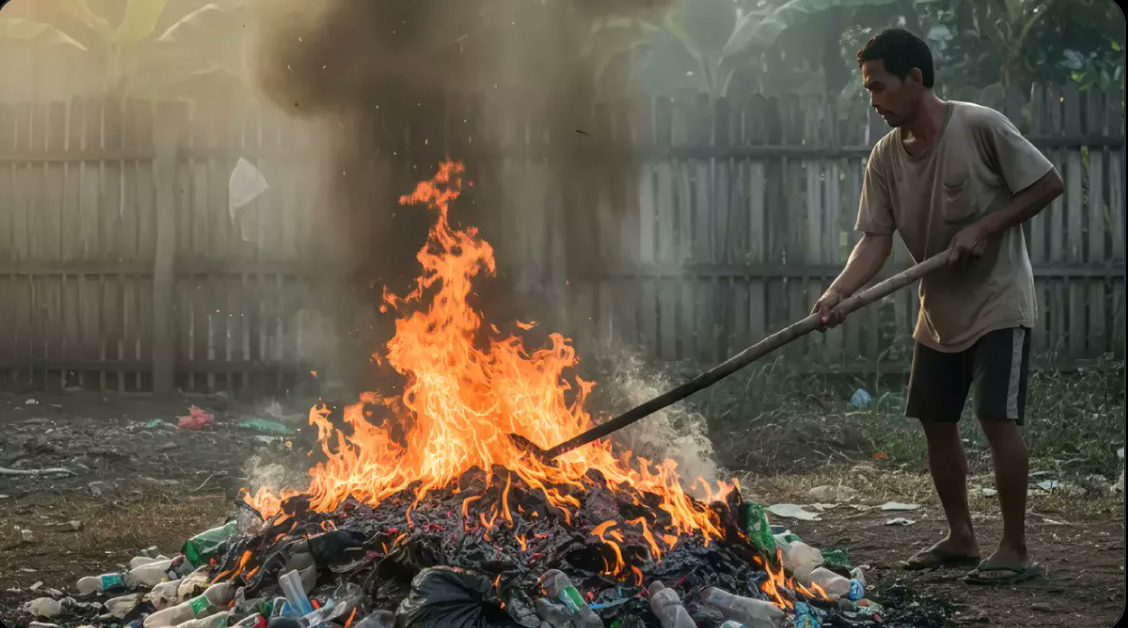
Bali was named the world's number one travel destination in January 2026. That same month, international arrivals declined year-on-year for the first time in years. From a descending plane, you can see why: smoke columns rising across central south Bali, dozens of them, merging into a haze above the most photographed island on earth.
The fires are not hard to explain. The island's primary landfill stopped accepting organic waste on April 1st, after four decades of receiving more than a thousand tonnes a day. The infrastructure meant to replace it doesn't exist yet. So people burn.
The first fire I next to my home was at the beginning of April. Across the river behind my compound in Umalas, a group of men burning household waste in a drainage channel. They didn't even look up. They turned the pile with a length of rebar as the smoke crossed the water and settled into the courtyard.
Just this last week, an elderly woman across the lane, burning in front of her gate. I made eye contact. My face must have registered something. She gave me a look back — not shame exactly, not defiance, but something in between. She kept burning, and I went inside.
She is not the problem. She is the end of the problem, standing in a lane with a match and nowhere to put what's in her hands. The garbage truck has been turned away from the landfill. There is no collection point within walking distance. Nobody has built one.
“She is not the problem. She is the end of the problem, standing in a lane with a match and nowhere to put what's in her hands.”
How We Got Here
The banjar — Bali's most local neighbourhood governance unit — was once a functional waste system. Not by design, but because the waste it managed was almost entirely organic: food scraps, plant material, the biodegradable residue of an agricultural life. The banjar collected. Customary law, awig-awig, enforced norms with spiritual rather than municipal authority. The waste decomposed and returned to the soil.
Plastic arrived in the 1990s on the back of the same tourism boom reshaping the island's economy. Within roughly a decade, a system that had managed waste for centuries had no answer for the new material. Plastic had no cultural category, no collection infrastructure, and no end-of-life pathway on the island. The organic model met a synthetic problem. Every fire burning today flows from that mismatch.
Bali’s resident population grew roughly 40–45% since 2000 while recorded waste rose about 30%, suggesting a per-capita decline—but that ignores tourism. With ~5–7 million annual visitors generating ~1.5–3× more waste per person and concentrating in key areas, the effective waste load likely exceeding population growth, especially during peak periods. The Suwung landfill absorbed the overflow for four decades, missing closure deadlines in 2022, 2023, 2025, and early 2026. Each extension was granted because no alternative had been built. One exists now, finally: a waste-to-energy facility planned for South Denpasar, backed by Indonesia's sovereign wealth fund and a Chinese operator, with groundbreaking planned for mid-2026 and operations targeted for 2028. Suwung closes fully in August 2026. In the eighteen months between those two dates, the island will generate more than half a million tonnes of waste with nowhere designated to receive it. The woman across my lane is living inside that gap.
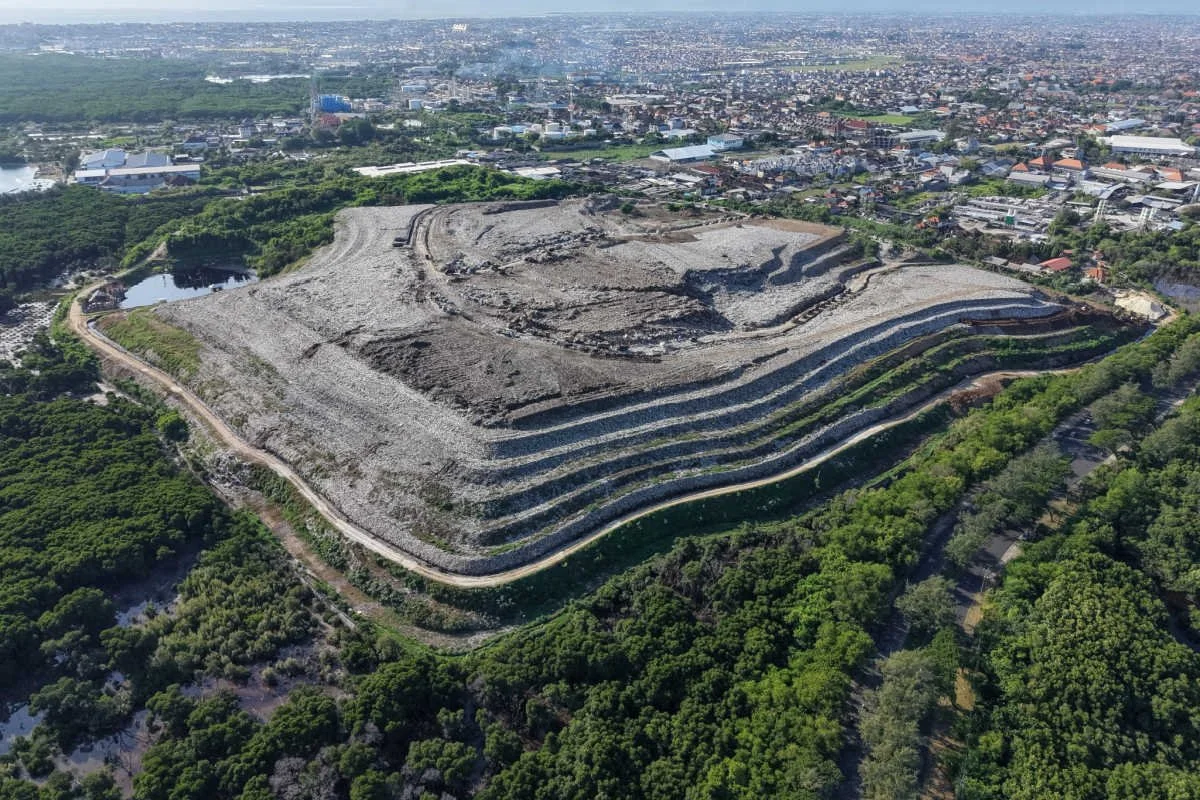
The Suwung Landfill (officially TPA Suwung) is the largest waste disposal site on the island of Bali, Indonesia
The Material All Around Us
At the same time the waste crisis deepened, Bali's construction industry accelerated. Hotels doubled in a decade — 249 to 541 between 2013 and 2023. The island loses roughly 2,000 hectares of agricultural land to new buildings every year. Architects and developers on this island are specifying materials constantly: what the floor is made of, what covers the roof, what lines the drainage channel, what paves the courtyard. Taken together, those decisions are one of the largest procurement systems on the island.
That system is currently buying concrete, clay, imported timber, and quarried aggregate. The material that could replace significant portions of all of it is being burned two hundred metres from the construction site.
The most visible design response to Bali's plastic problem arrived last year, at the scale of a single chair. Sungai Watch — the nonprofit that has installed more than 268 waste barriers across Bali's rivers, collecting over 1.8 million kilograms of plastic since 2020 — launched a sister company called Sungai Design. Their debut product, the Ombak chair, is made from 2,000 recovered plastic bags, heat-pressed into sheets and precision-cut by CNC machine. Designed with American designer Mike Russek, it retails for around $900 and takes thirty artisans a full day to produce. The Bencheghib siblings who built it grew up on this island. They started picking up beach plastic as teenagers. The chair is what happens when people who have spent years wading through Bali's rivers finally ask what all that plastic could become.
But design as argument and design as infrastructure are different things. The Ombak chair's natural customer is design-conscious, likely international — which means it frequently travels by container ship before it displaces a single piece of conventionally manufactured furniture anywhere. It is also not UV-stable, which limits it to indoor use in a tropical country defined by its outdoors. A chair measured in units cannot address a crisis measured in tonnes per day. What Bali needs is materials that go into the ground and stay there.
What Infrastructure Design Looks Like
The materials that could shift the equation are not the ones that photograph well in design publications. They are the ones that get specified by the thousands, poured into the ground, fastened to roof structures, and never looked at again. Three of them can already be made from Bali's waste stream, are certified to national standard, and are price-competitive with the conventional materials they replace.
“The material that could replace significant portions of all of it is being burned two hundred metres from the construction site.”
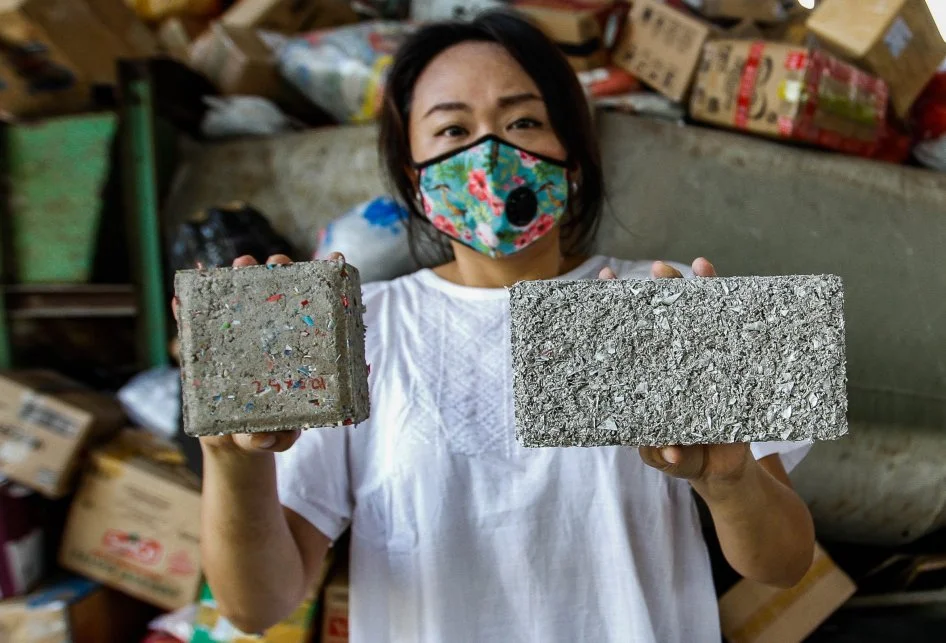
Jakarta based Rebricks is a female founded sustainable construction material company
The first is the brick. Jakarta-based Rebricks was founded in 2018 by two women, Ovy Sabrina and Novita Tan, who looked at a pile of sachet plastic — the multilayer noodle packets and shampoo sachets that no recycler in Indonesia will touch — and asked what could be built from it instead. After a year and a half of lab testing, they arrived at a two-layer paving block: a concrete top surface that contacts feet and vehicles, and a bottom layer of twenty percent shredded sachet plastic mixed with volcanic ash, mountain stone, and cement. The blocks are certified to Indonesian national standard at 250 kilograms per square centimetre — sufficient for parking lots and pedestrian areas. They don't crack under vehicle loads. The paving stones don't get slippery when wet. Price-competitive with conventional alternatives, they are used by community groups building affordable housing and sanitation facilities: buyers who have no margin for a premium. Each house built with Rebricks materials sequesters 270 kilograms of plastic that would otherwise be burned. Rebricks planned a Bali factory. The feedstock exists in unlimited supply. The limiting factor is not chemistry. It is specification.
The second is permeable paving. Bali's catastrophic September 2025 floods were as much an architectural failure as a climate one — the direct consequence of impervious surfaces replacing the porous landscape that once absorbed rainfall. Rice fields hold water. Concrete courtyards shed it. Around 1,000 hectares of agricultural land disappear across Bali every year to new development, each hectare converting absorbent ground to sealed surface. Recycled plastic permeable grid systems — interlocking honeycomb panels made from post-consumer plastic, filled with gravel or planted with grass — allow stormwater to infiltrate rather than overwhelm drainage channels. The pedestrian corridors Canggu urgently needs, the river-edge footpaths where flooding risk is highest, the parking areas of every new resort compound: all natural applications. The closed loop is exact: plastic that enters rivers, blocks drainage channels, and causes floods becomes the surface material that absorbs rainfall and prevents them.
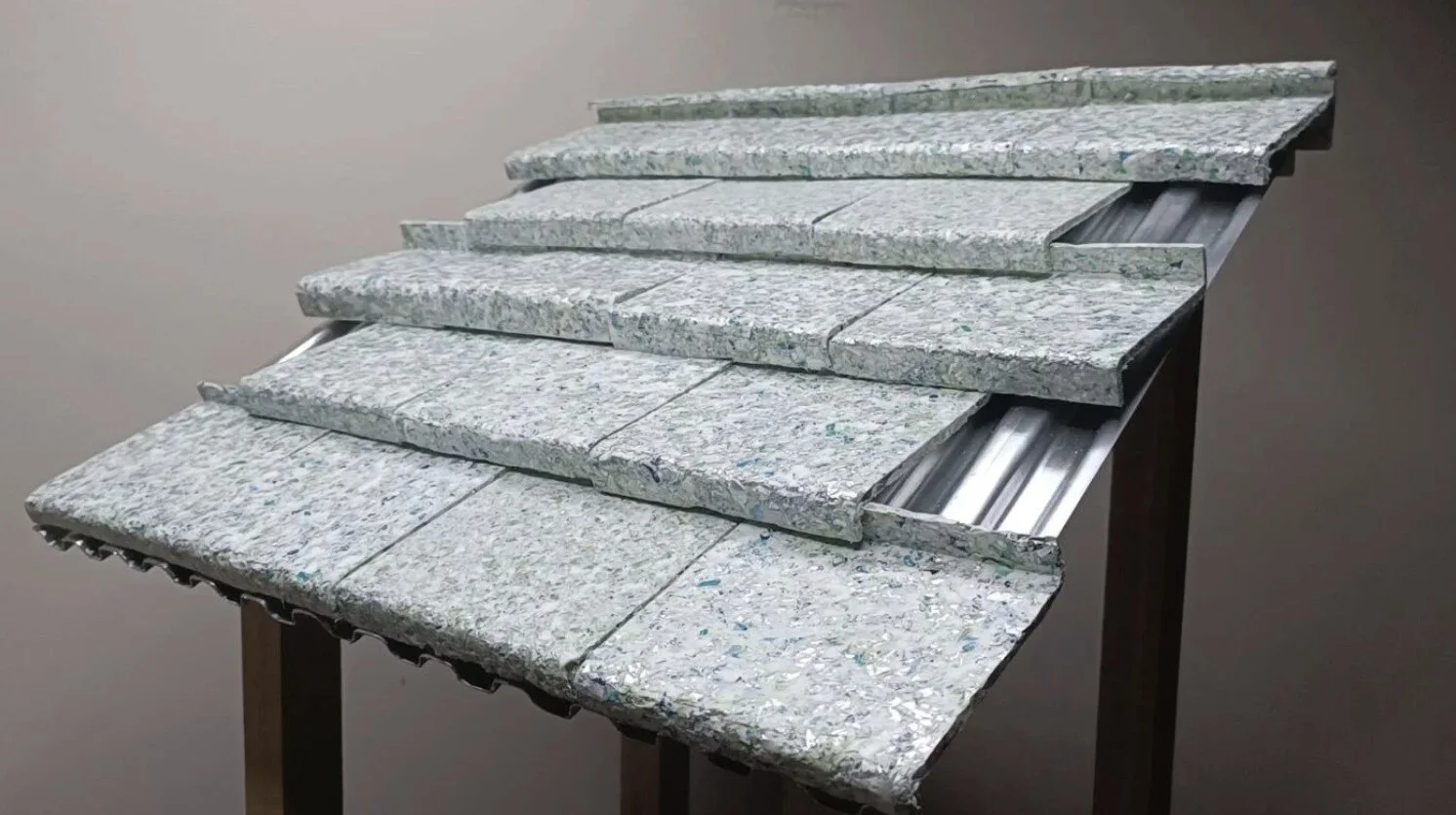
AZoCleantech plastic roof tiles are high-performance, eco-friendly alternatives to traditional clay or concrete roofing.
The third is roofing. Recycled plastic roof tiles with UV-stabilising additives last between thirty and fifty years and weigh between 0.7 and 1.1 kilograms each — compared to 4.5 to 6.8 kilograms for clay. That weight difference matters in ways that go beyond cost and logistics. Indonesia sits on the Pacific Ring of Fire. Bali alone has experienced multiple significant earthquakes in the past decade, and roof collapse is a leading cause of structural fatality when buildings fail. A roof five to six times lighter than clay reduces the dead load on walls and foundations, which is a structural engineering argument before it is an environmental one. A typical three-bedroom house fitted with recycled plastic tiles removes approximately 1.5 tonnes of plastic from the waste stream. The buyer is not a boutique hotel assembling a sustainability narrative. It is every school, community hall, market building, and worker housing project being built across the island right now.
Creating the Demand
None of these products reach scale without consistent demand from the people who specify what buildings are made of. In Bali, those people are architects and developers working through an active construction cycle on one of the most visited islands in the world. The question at the material specification stage has always been: does this product perform? It now needs a second question alongside it: where does it come from, and could something equivalent be made from what this island is burning?
That second question, asked across enough projects, is a procurement policy. It is how material industries get built — not through government programmes or certification schemes, but through the accumulation of individual decisions by the people who design things. A mandate requiring minimum recycled plastic content in publicly funded construction — roads, drainage, the hundreds of banjar-level waste sorting facilities now being built island-wide — would create institutional demand that private specification alone cannot generate. Indonesia's construction sector has a documented problem with material substitution in public contracts, so any such mandate would need third-party certification to mean anything. But the political moment for that argument is now. South Korean diplomatic complaints, declining arrivals, air quality readings of 150 above Bali's tourist zones. The cost of inaction is no longer abstract. It is in the air.
“A mandate requiring recycled material in public construction would create demand at a scale private projects alone cannot.”
Plastic-composite paving, permeable grid surfaces, and recycled plastic roofing are the clearest applications. Wood-plastic composite lumber, manufactured in Indonesia from recycled HDPE and sawmill waste, outperforms raw timber in tropical humidity and relieves pressure on forests being logged to feed the same construction boom generating the plastic. Composite manhole covers and drainage grates made from recycled plastic and fiberglass resin outlast cast iron in Bali's salt-humid coastal environment and don't get stolen from streets — a chronic problem that leaves open drainage holes across Denpasar every rainy season. What all of these lack is an architect who has put them in a specification.
The River Keeps Moving
Ninety percent of Bali's residents live within a kilometre of a river. During the monsoon those rivers carry everything left on their banks directly to the coast. Sungai Watch's barriers intercept part of that flow. They work, and the organisation that built them understands better than almost anyone what the island is up against. "Recycling is not the solution," the founders have said. "It's all about reduction." The Ombak chair makes that argument beautifully. What Bali needs now are buildings that make it too — at the scale the problem demands, for the decades the materials will last, visible to every architect who visits and every developer who builds.
Bali has been building and burning simultaneously for thirty years. The design community has been building throughout, specifying materials that arrive by container ship while the material that could replace them burns in the lane outside. The next chapter of how this island is built — literally, in paving and roofing and drainage — will be determined by decisions already being made on drawing boards across Canggu, Seminyak, and Ubud. The waste stream is a local supply chain waiting for a way to close the loop. This is no longer a design choice. It is a design criteria.
“This is no longer a design choice. It is a design criteria.”
Sources: Waste generation and landfill data: Institute for Essential Services Reform (IESR), February 2025; National Waste Management Information System (SIPSN), 2024. Tourism arrivals: Bali Hotels Association, January 2026; BPS Statistics Indonesia. Suwung closure and PSEL agreements: Antara News, April 2026; The Bali Sun, April 2026; Bali Politika, April 2026. Danantara WtE programme: Tempo, March–April 2026. Rebricks materials and specifications: company documentation; Thomson Reuters Foundation, August 2023; International Society for Concrete Pavements, 2020. Ombak chair: Dezeen, April 2024; Fast Company, March 2024; Atmos Earth, 2025. Roof tile weight data: S Jones Roofing, 2025; Gaggino et al., Advances in Civil Engineering, 2018. Sungai Watch: Impact Report, 2024. Air quality: IQAir, April 2026. Hotel growth: BPS Bali, 2023.