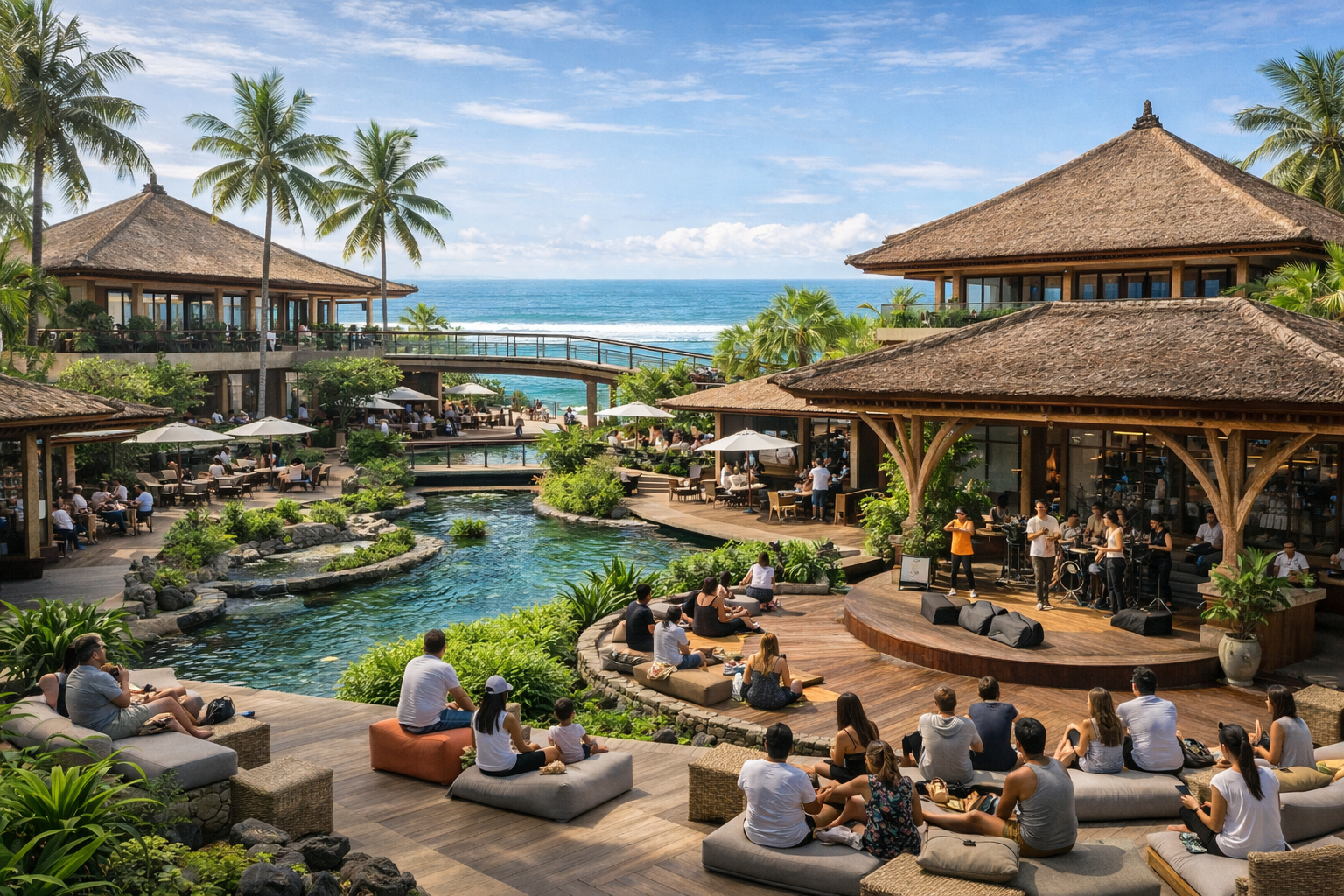
Outdoor al fresco dining and year round entertainment
The Case for a Shopping Mall in Canggu
I know what you're thinking. A mall? In Canggu? Among the rice paddies, cacao smoothie bowls, and people doing breathwork at 7am on the beach.
I live here. I ride my scooter through the chaos of Batu Bolong every day. I've watched this stretch of coast transform in just a few years from a slow-burning surfer enclave into one of the most talked-about neighbourhoods on earth. In 2024, Pererenan was named the Best Neighbourhood in the World by TimeOut Magazine, which is either thrilling or terrifying depending on where you stand. Now, whether we're ready or not, Canggu is preparing for its biggest shift yet. Its first full-scale shopping mall, Canggu Hills Shopping Centre, is currently under construction and scheduled to open in 2028.
The reaction online has been predictable. Expat Facebook groups are seething. People who moved here three years ago to escape modernity are suddenly very concerned about modernity arriving. But the conversation surrounding this project is missing the point. The real question isn't whether a mall belongs in Canggu. The real question is what kind of city Canggu is becoming.
“The real question isn’t whether a mall belongs in Canggu. The real question is what kind of city Canggu is becoming.”
A Socialist Invented the Mall
The origin story of the shopping mall is more surprising than most people realise.
The modern mall was the invention of a Viennese socialist named Victor Gruen. Born in 1903, Gruen fled to the United States after the Nazi occupation of Austria, arriving in New York with an architecture degree, eight dollars, and no English. In 1956 he designed Southdale Center in Minnesota, the first fully enclosed shopping mall in America.
His idea was never meant to be purely commercial. Gruen hated suburban sprawl and the car-dependent landscapes spreading across postwar America. What he wanted to build was a town square, a climate-controlled version of the public plazas and streets he grew up with in Vienna. His original plans included housing, schools, parks, medical facilities, and civic institutions alongside the shops. He was trying to recreate the social life of the European city in a new context.
What actually spread across American suburbs was a stripped-down version of that vision. Retail survived. Community did not. Gruen became so disgusted with what the mall had become that he disowned it entirely, famously refusing to pay what he called alimony for “those bastard developments.”
In Southeast Asia, though, something closer to his original idea quietly came to life. Walk through a well-designed mall in Bangkok, Kuala Lumpur, or Jakarta and you'll find fountains, gardens, food courts with grandmothers and toddlers side by side, teenagers in clusters on benches, and families spending entire Sunday afternoons wandering through covered corridors with nowhere particular to be. Bangkok’s ICONSIAM hosts cultural exhibitions and artisanal markets alongside its retail floors. Singapore’s Jewel Changi draws crowds with its indoor waterfall and lush gardens. These aren't simply shopping centers. They're the public living rooms of tropical cities.
Canggu doesn't have one.
Where Do the Teenagers Go?
Here's a question that rarely gets asked: where do teenagers in Canggu actually go?
If you're 16, Indonesian and want to spend a Saturday afternoon with friends, what are your options? The beach works, except during the months of heavy rain. You can sit at a warung if you keep ordering something. Hanging outside the Minimart isnt ideal. The beach clubs colonising the coastline are expensive, and really meant for tourists. Minimum spends make that clear. Wellness studios, boutique gyms, and coffee shops charging international prices aren't really accessible either.
The mall solved this problem everywhere it appeared. It's genuinely free to enter. You can walk the corridors, sit by a fountain, meet friends near an escalator, buy one cheap snack, and stay for hours. The mall has always been one of the most age-inclusive social environments ever built. Retirees and school kids share the same space without anyone asking them to leave or spend more money.
In a place like Canggu, where almost all social infrastructure has been shaped by tourism and priced accordingly, that kind of open access matters more than it might seem.
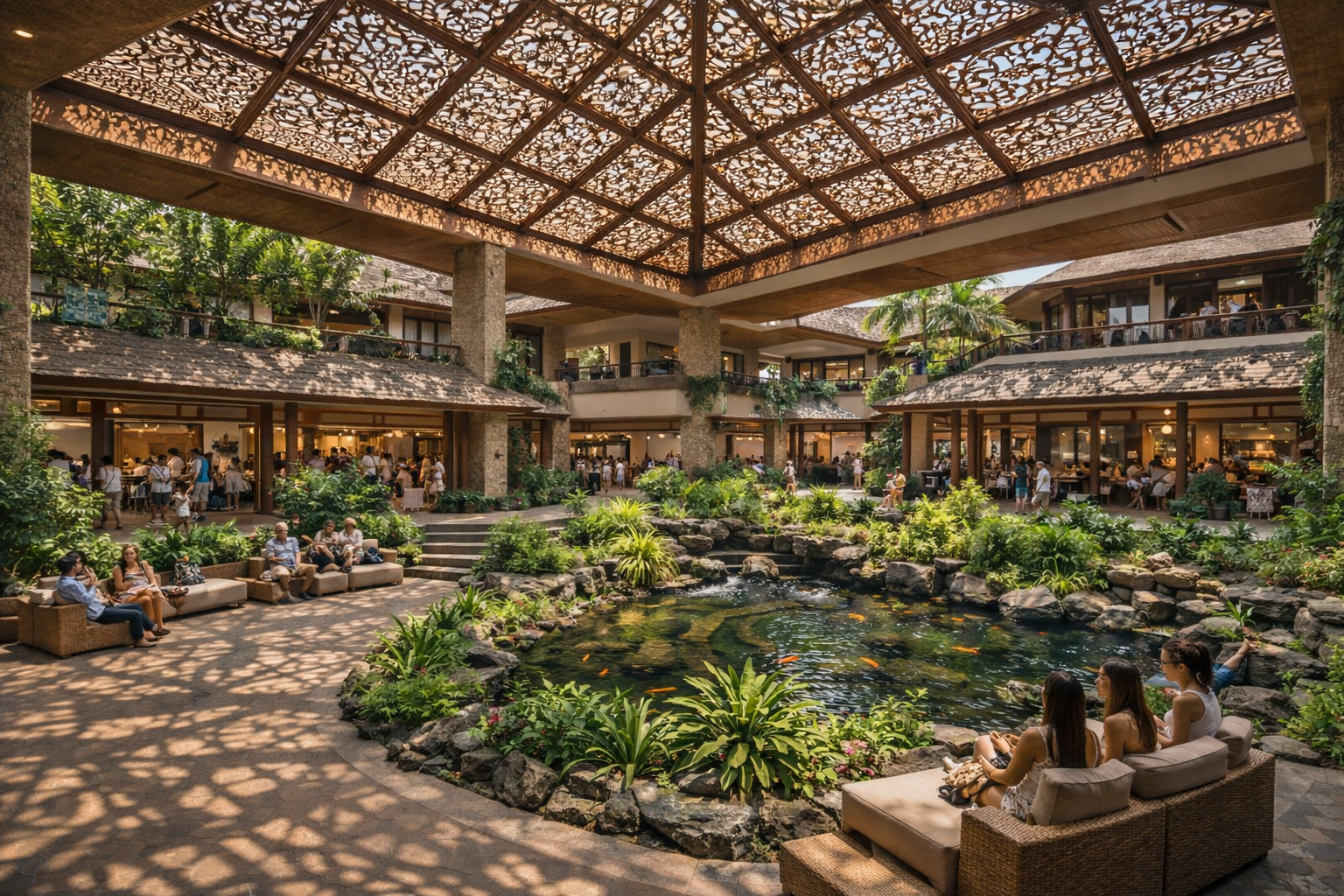
Large indoor spaces with Balinese motifs serve as social nodes
The Weather Problem
Canggu receives roughly 2.5 meters of rain each year. From November through April, storms arrive suddenly and often.
Outdoor parks sound good in a masterplan. During the wet season they turn into muddy, underused strips of ground. They function as seasonal infrastructure, which is another way of saying they don't fully work.
A well-designed tropical mall addresses this directly. Not a sealed glass box, but an open-format complex with shaded walkways, interior courtyards, and natural ventilation. Canggu Hills has been described in those terms, built around outdoor streets and courtyards rather than enclosed retail corridors. If that vision is followed through with genuine architectural commitment, it could become exactly the kind of climate-responsive public space the area currently lacks: protected from rain, naturally ventilated, and actually walkable.
It Is Happening. The Question Is How.
Pererenan was, until very recently, a quiet coastal village visited mostly by surfers and backpackers. Within a decade it became one of the most talked-about addresses in Southeast Asia. The land around it is already changing. Between 2019 and 2024, Bali lost over 6,500 hectares of productive agricultural land, roughly 9 percent of its farming landscape. Rice paddies continue to be converted into villas, guesthouses, and commercial strips, steadily and without much public debate.
This is the context in which the proposed mall is being discussed, and it's why much of the opposition to it feels aimed at the wrong target. The people protesting a mall are not protesting development. They are protesting this particular development while hundreds of private villas and guesthouses quietly replace the same land with no coordinated planning, no shared infrastructure, and no public benefit whatsoever.
Critics have raised legitimate concerns about traffic, land conversion, and environmental impact. The project is branded as Ecovista, which has prompted pointed questions in local Indonesian media about how a development with 200 retail tenants and dozens of luxury villas can honestly carry an ecological identity. One outlet described it as classic greenwashing, selling an eco name to attract environmentally conscious foreign buyers while adding concrete to water catchment land. Those questions deserve serious scrutiny and the developer should be held to them.
But the alternative to this mall isn't preserved rice fields. The alternative is more of the same: another wave of private development with no public benefit, no water management, no coordinated circulation, and no shared space. More of the same isn't preservation. It's just a slower version of the same loss.
“More of the same isn’t preservation. It’s just a slower version of the same loss.”
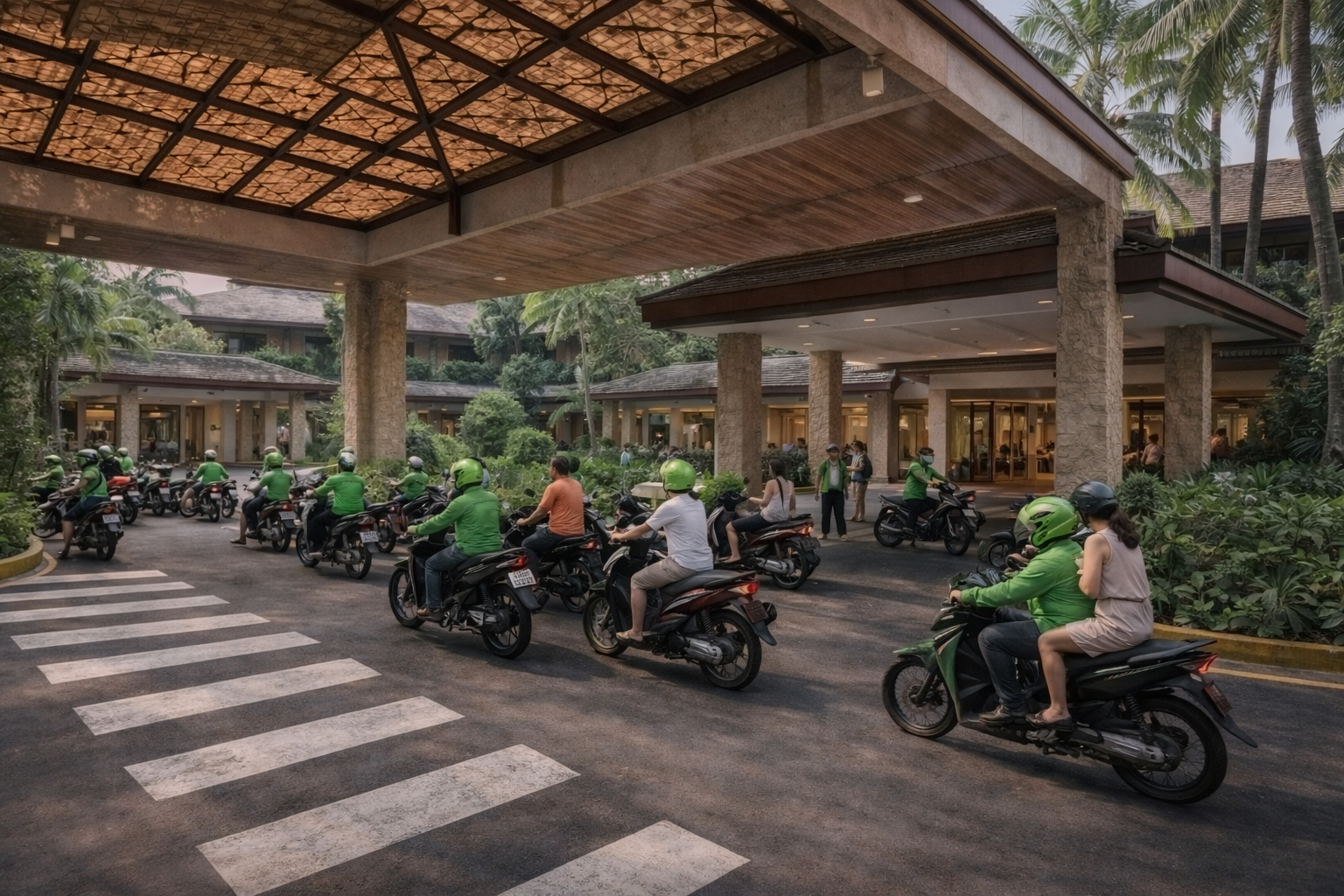
Organized pick up and drop off zones are just the beginning of infrastructural improvements
Infrastructure Is the Real Argument
The strongest case for a well-designed mall in Canggu isn't the retail. It's the infrastructure a project of this scale is obligated to build, and that smaller projects simply never do.
Right now a significant share of the vehicles clogging Jalan Raya Canggu are headed somewhere else entirely. People drive south to Seminyak or all the way to Denpasar for a supermarket run, a pharmacy, a decent mid-range restaurant. That daily migration is baked into the area’s traffic. A local destination with a proper retail anchor absorbs much of that movement. It doesn't add load to the main roads toward Denpasar and Kuta. It reduces it.
Beyond traffic, large-scale developments carry obligations that smaller ones never face: engineered stormwater management, underground cisterns, bioswales, permeable surface requirements, organized parking with rational entry and exit points. Canggu’s congestion and flooding aren't the result of bad intentions. They're the result of development happening parcel by parcel, each project too small to be required to fix anything beyond its own footprint. A project of real scale changes that equation.
Look at what anchor developments have done elsewhere in the region. Greenbelt in Makati gave an entire district its organizing logic, bringing investment, pedestrian infrastructure, and public space to an area that previously lacked all three. SM Mall of Asia transformed reclaimed bay land in Manila into a mixed-use hub with parks, transit connections, and a recognizable civic identity. These projects didn't just introduce retail. They gave their surroundings a center.
Canggu has no center. It has a coastline and a series of roads leading away from it.
What It Would Need to Be
This isn't an argument for any mall. It's an argument for a good one, which is a different thing.
A good mall in Canggu would respond to its environment rather than ignore it. Not a generic retail box, but something with open courtyards, natural ventilation, local materials, and integrated planting. Something that feels closer to a covered tropical village than a shopping shed. Environmental accountability would need to be real, not branded. Rainwater harvesting, permeable surfaces, and responsible drainage systems built into the project from the start, not added as marketing language at the end.
Local employment should extend beyond parking attendants and security guards into meaningful roles in management and operations. And the space itself should remain genuinely accessible. Families, teenagers, and local residents should feel welcome to spend time there without financial pressure to keep spending.
The Conversation Worth Having
Movements declaring that Bali should belong to Balinese residents reflect real and growing frustration. Much of the island’s development over the past decade has served tourism and foreign capital almost exclusively. What's missing isn't less development. What's missing is development that genuinely serves the people who actually live here.
A thoughtfully designed mall can do that. Publicly accessible. Weather-proof. Multigenerational. It creates employment and can anchor infrastructure improvements that extend outward into the surrounding streets, drains, and footpaths in ways that no villa compound ever will.
Victor Gruen spent the later years of his life furious that his original idea had been reduced to pure commerce. But the idea at its core was a good one: a shared civic space where people of all kinds could gather, wander, and simply spend time together. On a rainy afternoon somewhere in Southeast Asia, in the covered walkways of a well-designed mall, that idea is still alive.
Canggu could use some of it.